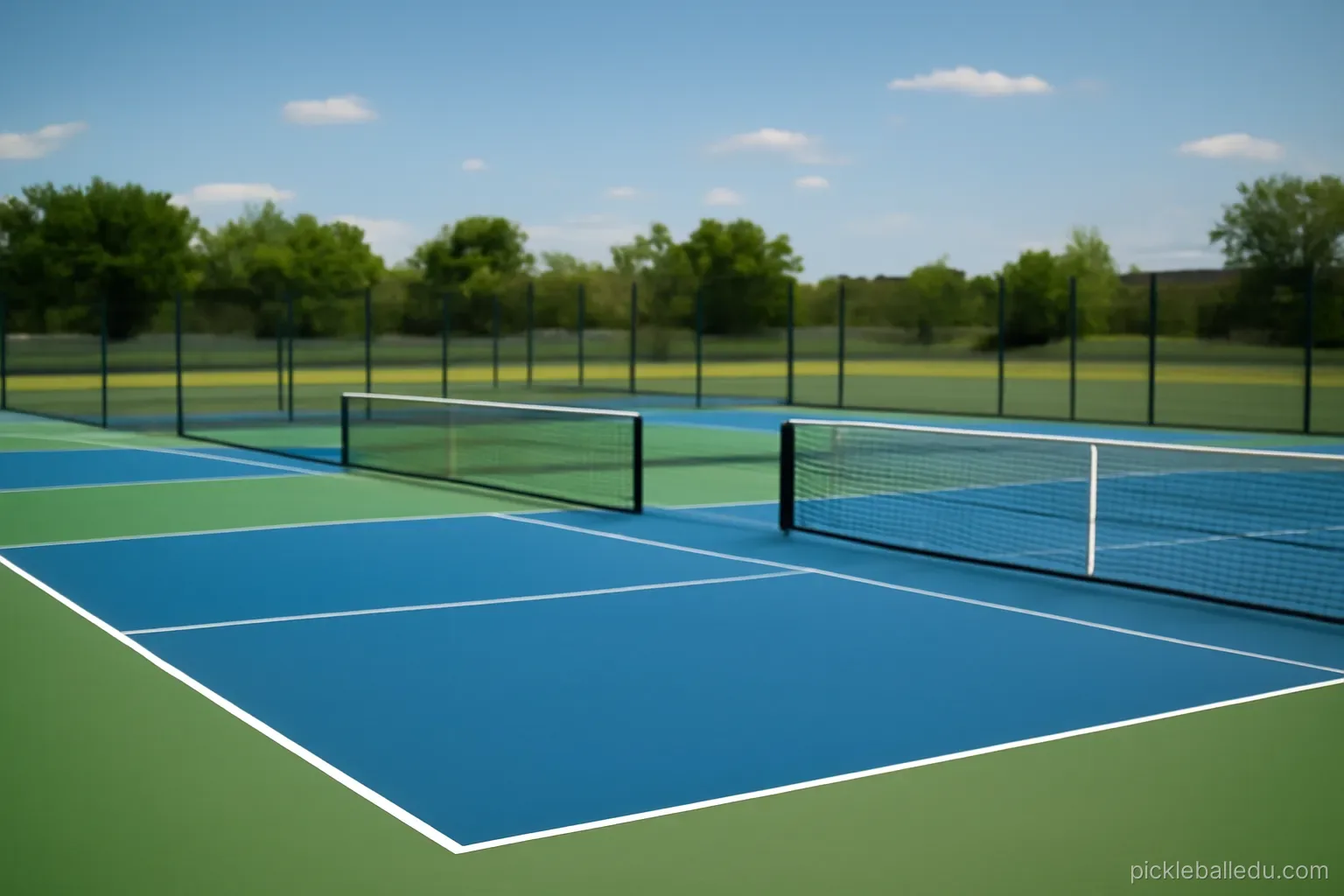
Almost everywhere the sport has grown, the same complaint follows: there are not enough courts.
Groups that successfully get courts built usually discover that the construction is the easy part. The hard part is persuasion, siting and the neighbours.
The options, cheapest first
Lines on an existing surface. Tennis courts, basketball courts, sports halls. Temporary tape or painted lines, portable nets. By far the fastest route to more playing time.
Shared marking on tennis courts. Permanent additional lines. Cheap, but expect negotiation with existing users — this is where most conflict arises.
Converting an underused court. One tennis court fits several pickleball courts. Often the best value where a facility has spare capacity.
Resurfacing an existing hard surface with proper court coating and permanent lines.
New dedicated courts. Best experience, highest cost, longest timeline.
Indoor space. Sports halls, unused warehouses, community centres. Weather-proof and increasingly popular — but noise indoors is a serious consideration.
Making the case to decision makers
Whoever controls the space — a council, a club committee, a school, a landowner — responds to evidence, not enthusiasm.
What actually persuades:
- Numbers. How many people currently play locally, how many are turned away, how long the waiting is.
- Demographics. This sport reaches people other facilities do not — particularly older adults, who are usually a priority group for public health.
- Utilisation. Pickleball courts get used far more hours per week than most facilities, across a wider age range.
- Cost per participant. Several courts fit in a small footprint and serve many people.
- Health outcomes. Regular moderate activity and social connection in older adults are both things public bodies actively want.
- A funding plan rather than a request. Grants, club contribution, phased approach.
What does not persuade: passion alone, complaints about tennis players, or a request without a plan.
Practical advice: collect names and numbers first. A list of two hundred interested local people is more convincing than any argument.
Siting: where most projects go wrong
The single biggest risk to a new court project is noise, and groups consistently underestimate it.
- The impact sound of the ball is sharp and repetitive, and carries further than people expect.
- It is the repetition rather than the volume that generates complaints.
- Courts have been closed after being built because of noise objections. Getting this wrong can undo the whole project.
Reducing the risk:
- Site courts away from housing wherever possible. Distance is the most effective mitigation by a wide margin.
- Consider orientation and any natural barriers — buildings, embankments, dense vegetation.
- Look into acoustic fencing if courts must be near homes.
- Quieter paddle and ball options exist and are worth investigating — the field is developing.
- Agree operating hours in advance and enforce them. Early morning play is the most common trigger for complaints.
- Talk to neighbours before building, not after. People object far more strongly to something imposed on them than to something they were consulted about.
Other siting factors
- Orientation. Courts running north–south reduce sun in players' eyes; get local advice.
- Wind exposure — outdoor play becomes frustrating in consistent wind.
- Drainage. Standing water makes courts unusable and unsafe.
- Parking and access, including step-free routes.
- Toilets and shade. Both matter more than people expect, especially for older players.
- Lighting if evening play is intended — plan for it from the start, as retrofitting costs far more.
- Space between courts and behind baselines. Cramming courts in creates collisions.
Surface and construction
- Get a proper base. Almost all court failures come from what is underneath, not the surface layer.
- Use a contractor with sports court experience. A general paving contractor will often produce something that cracks or drains badly.
- Ask for references and go and look at their previous work.
- Get the slope right for drainage — this is specified and it matters.
- Choose the surface for your climate and expected usage.
- Confirm dimensions and net height against current official specifications before construction, not after.
- Consider fencing height — chasing balls into a road is both annoying and dangerous.
Ongoing maintenance
Budget for this from the start; neglected courts become unsafe.
- Sweep regularly. Debris is a slip hazard and grinds down the surface.
- Clear standing water and keep drains free.
- Treat moss and algae — a major slip risk in damp climates.
- Repair cracks early. Water gets in and small cracks become expensive ones.
- Repaint lines as they wear.
- Check nets and posts for damage.
- Inspect fencing and gates.
- Plan for resurfacing on a long cycle and set money aside annually.
Sharing courts well
Where facilities are shared, the arrangement matters as much as the surface:
- Agree a booking system everyone can see.
- Set clear time blocks for each sport rather than leaving it to negotiation.
- Store portable nets accessibly and agree who sets up and puts away.
- Be good tenants — leave it tidy, respect the times, fix what you break.
- Build a relationship with the other users. Most shared-court conflicts are really relationship problems.
One thing worth remembering
Groups that get courts built are rarely the ones with the best arguments. They are the ones who turned up consistently, brought numbers, and made it easy for a decision maker to say yes.
And the ones whose courts survive long term are the ones who took the neighbours seriously from the beginning.
Câu hỏi thường gặp
What is the fastest route to more playing time?
Lines on an existing surface — tennis courts, basketball courts or sports halls with temporary tape and portable nets, before considering any construction.
What is the biggest risk to a new court project?
Noise. The impact sound is sharp and repetitive and carries further than people expect — courts have been closed after being built because of noise objections.
How do you reduce noise risk?
Site courts away from housing since distance is by far the most effective mitigation, consider barriers and acoustic fencing, agree operating hours in advance, and talk to neighbours before building rather than after.
What actually persuades decision makers?
Numbers of interested players, demographics reaching groups other facilities do not, high utilisation hours, cost per participant, and a funding plan rather than just a request.
Where do most court failures come from?
The base underneath, not the surface layer — which is why using a contractor with genuine sports court experience matters.