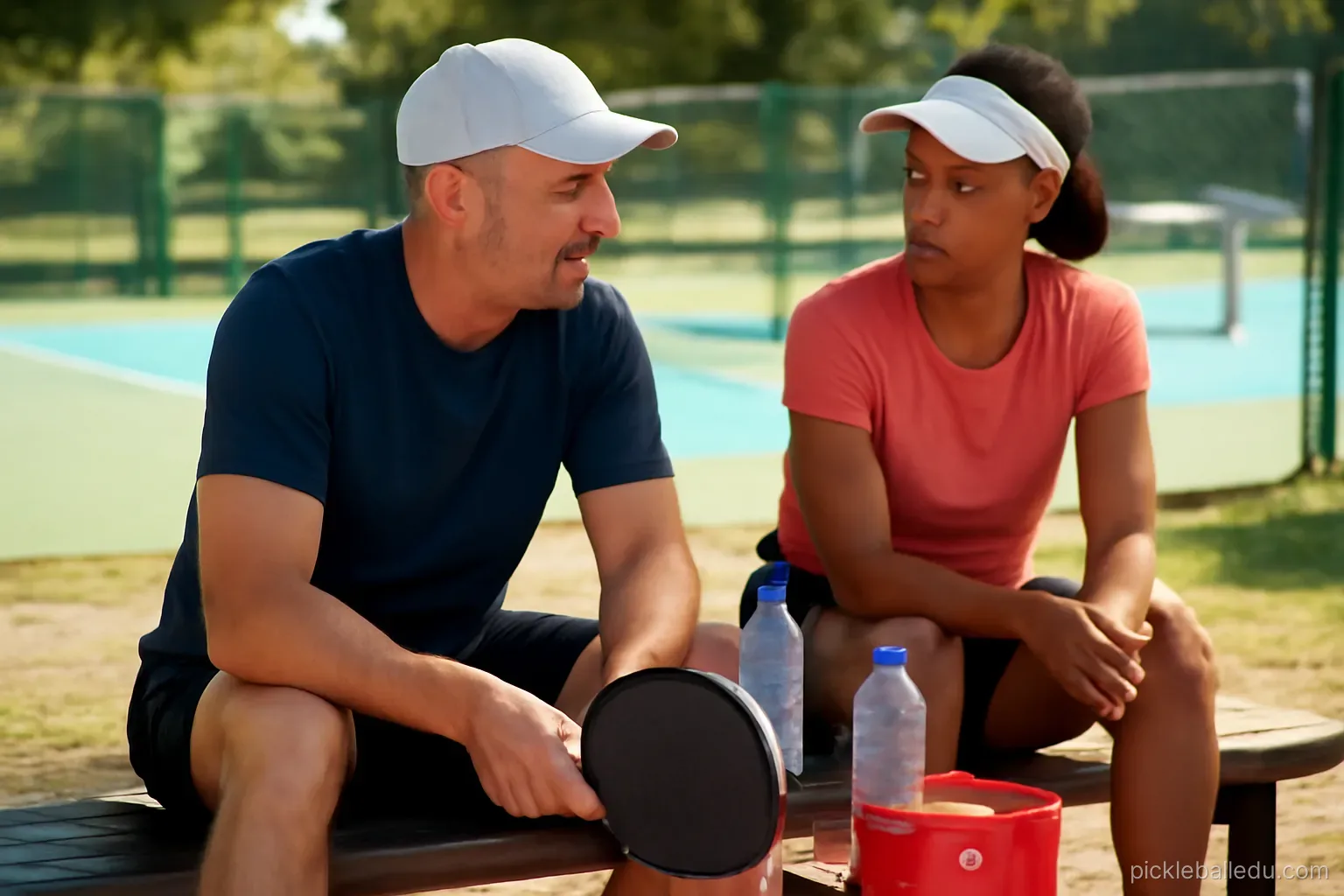
Pickleball is one of the few sports where players in their twenties and players in their seventies share the same court. That is a large part of its appeal.
It also means that every club should be prepared for a medical emergency — and that most players have never thought about what they would do in the first two minutes.
Important note: this article is general information to help you recognise a serious situation and call for help. It is not medical training. If you play or organise regularly, take a certified first aid and resuscitation course — a few hours of real training is worth far more than any article.
Signs that require calling emergency services immediately
Stop play and call for help if a player shows any of these:
Possible cardiac event:
- Chest pain, pressure or tightness.
- Pain spreading to the arm, jaw, neck or back.
- Sudden severe shortness of breath.
- Cold sweat with nausea.
- Collapse, or unresponsiveness.
Possible stroke:
- Sudden drooping on one side of the face.
- Weakness in one arm.
- Slurred or confused speech.
- Sudden loss of vision or balance.
Head injury:
- Any loss of consciousness, even brief.
- Confusion, repeated questions, memory gaps.
- Vomiting, worsening headache.
- Unequal pupils.
Heat illness:
- Confusion or unusual behaviour.
- Hot skin with no sweating.
- Fainting.
Severe allergic reaction:
- Swelling of face, lips or throat.
- Difficulty breathing.
- Widespread rash with faintness.
The rule that matters most: when in doubt, call. Emergency services would far rather attend a false alarm than arrive late to a real one — and the strongest predictor of survival in a cardiac arrest is how fast help begins.
What to do while help is coming
- Send one specific person to call — say their name. In a group, if you say someone call for help, everyone assumes someone else did.
- Send another specific person to fetch the defibrillator if the venue has one.
- Send a third person to meet the ambulance at the entrance and guide it in. Large sports complexes are hard to navigate and this saves real minutes.
- Clear space around the person.
- Do not move someone with a suspected head, neck or back injury unless they are in danger where they lie.
- Stay with them and keep talking, even if they are not responding.
- Follow the dispatcher's instructions — they are trained to guide you through what to do.
If someone collapses and is not breathing normally: this is cardiac arrest. Begin resuscitation and use a defibrillator if one is available. Both are things you should learn properly in a course — the devices give spoken instructions and are designed for untrained users, but confidence comes from having practised.
Why defibrillators matter for this sport
- Survival from cardiac arrest drops sharply with each minute of delay.
- Ambulance response takes time even in cities.
- Modern devices talk the user through every step and will not deliver a shock unless it is needed.
- The demographics of pickleball make this more relevant than in many other sports.
If you organise play, find out: does the venue have a defibrillator, where exactly is it, is it checked and in date, and does anyone on site know how to use it? These are reasonable questions and any well-run venue will answer them.
Heat: the most common serious problem
Outdoor courts get hot, and heat illness builds gradually — which is why players push through it.
Early signs — stop playing: heavy sweating, cramps, headache, dizziness, unusual fatigue, nausea.
Danger signs — emergency: confusion, agitation, hot skin without sweat, fainting.
Prevention:
- Drink before you feel thirsty; thirst lags behind need.
- Take shade breaks between games, not only when you feel bad.
- Avoid the hottest hours of the day.
- Build up gradually when the season turns hot — acclimatisation takes days.
- Light coloured, breathable clothing and a hat off court.
- Check on older players and newcomers — they are at higher risk and least likely to say something.
If someone shows early signs: get them into shade, cool them with water and airflow, give fluids if they are fully alert. If they are confused or not fully alert, call emergency services and start cooling immediately.
Common court injuries
Ankle sprains — the most frequent pickleball injury. Stop play, do not try to walk it off. Seek assessment if there is significant swelling, if weight bearing is impossible, or if pain is severe.
Falls backward — often when chasing a lob. These carry real risk of wrist fracture and head impact. Learn to turn and run rather than backpedal; it is the single best habit for preventing serious injury in this sport.
Eye injuries — balls and paddles at the kitchen line move fast. Protective eyewear is worth considering, especially at higher levels.
Overuse injuries — elbow, shoulder, knee. These build slowly; pain that persists after rest needs assessment rather than more play.
Playing with a known condition
- Tell someone you play with regularly what your condition is and what to do.
- Carry your medication where it can be found — in your bag on the bench, not locked in a car.
- Wear medical identification if you have a serious condition.
- Get medical advice before returning after any cardiac event, surgery, or significant illness.
- Know your own warning signs and stop when they appear, even mid point.
What clubs and organisers can do
- Post the emergency number and the exact venue address somewhere visible. In a crisis, people forget where they are.
- Know your access point for an ambulance and make sure gates are not locked.
- Have a stocked first aid kit and someone who knows where it is.
- Encourage first aid training among regular players; some clubs organise a session.
- Keep emergency contacts for members.
- Have a heat policy — a temperature at which play is paused, agreed in advance rather than argued about on the day.
- Brief new members on where the first aid kit and defibrillator are.
Afterwards
- Check on the people who helped — witnessing an emergency affects people, sometimes days later.
- Review what happened as a club, without blame, and fix what was slow or missing.
- Respect privacy — do not share details of someone's medical event.
One thing worth remembering
Nobody expects to be the person standing over a collapsed player. But in a sport played by hundreds of thousands of people, many of them older, somebody will be — and it may be you.
Knowing the emergency number, knowing where the defibrillator is, and having done a first aid course once is a very small investment against that possibility.
Câu hỏi thường gặp
When should I call emergency services?
When in doubt, call. Emergency services would far rather attend a false alarm than arrive late — and the strongest predictor of survival in cardiac arrest is how fast help begins.
What is the most common mistake in a group emergency?
Saying: someone call for help. Everyone assumes someone else did it. Point at a specific person, say their name, and give them one task.
Why do defibrillators matter especially in pickleball?
Because survival from cardiac arrest drops sharply each minute, ambulance response takes time, and the age range of pickleball players makes this more relevant than in many other sports.
What is the best habit for preventing serious injury?
Learning to turn and run rather than backpedal when chasing a lob. Falls backward carry real risk of wrist fracture and head impact.
How do I know if heat illness is an emergency?
Early signs like cramps, dizziness and nausea mean stop playing. Confusion, agitation, hot skin without sweat, or fainting are emergencies — call for help and start cooling immediately.